

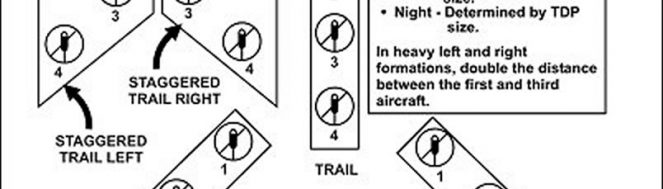
This article will cover the most common formations used in huey transport (slick) flights:
It will also cover more general formation topics:
Trail
Trail formation is simply recognized as a single-file line, like a row of ducks. Trail formation is most effectively utilized in the following ways:

- During quick turns
- If the formation has someone flanked out to the left or right of the flight leader, they have to adjust their speed to maintain their position in the formation through the turn.
- In trail formation, all helicopters should be operating with the same turn radius, and should therefore not have to adjust their collective to maintain their formation & spacing.
- Through narrow spaces
- As you can imagine, a single file line is an effective way to squeeze through a tight space, particularly when flying contour or nap-of-the-earth.
- Before takeoff
- Trail is a practical formation to line up in before takeoff, so that the flight can unambiguously establish their chalk order. Also for our purposes the chalk count (number of helicopters in the flight) is easy to perform in this formation.
Combat Cruise
The Combat Cruise formation can be thought of like a more relaxed version of the Trail formation. Like in trail, the chalk order is always explicit and observed; no helicopter is allowed to overtake another, nor to get up and fly alongside another helicopter.

In Combat Cruise, each chalk behind the leader has the authority to travel anywhere in the horizontal domain of their established chalk number, within a roughly 180° boundary behind the chalk in front of them.
Combat Cruise is useful, as the name implies, in combat situations:
- When evasive action is likely to be needed
- Flights in combat cruise are more dynamic and able to adjust to different situations more easily.
- Avoiding obstacles, especially when flying contour or nap-of-the-earth, is a good thing.
Staggered Columns
Staggered Column formations exist in different, mirrored versions of each other. Usually our slick flights utilize Staggered Left or Staggered Right columns. The name of these formations are often simplified to “Stagger Left” and “Stagger Right.”

In a Stagger Right formation, there are 2 single-file lines (trail formations), with chalk numbers alternating chalk 2 having chalk 1 45° to their left, and the other chalks alternating having the chalk above them 45 degrees to their right or left, but always being directly behind the chalk that is 2 ahead of them.
A way to visualize Stagger Right formation is to imagine a zipper on your coat or jeans. When unzipped (staggered), the teeth alternate left to right but neither tooth is right next to the other.
Staggered column is a preferred formation for long-distance directional flights. The benefits of staggered column are that there is increased depth perception, and if the flight slows down or speeds up, you can perceive it more easily as you are maintaining your 45° formation with your superior chalk, rather than having to see the helicopter directly in front of you get bigger or smaller. This promotes slower speed corrections, and helps mitigate the “accordion effect” that is most prominent in formations like Trail, where linear depth perception is really all you have.
Staggered Columns can be compared to Combat Cruise formation. Where in Combat Cruise, each chalk has their whole horizontal area to play with, in Stagger, they only have 1/2 of that, to the left OR right of their superior chalk, depending on their chalk order. Additionally, there is typically less wiggle-room in a staggered formation, and the chalks should maintain as close to 45° as possible off of their superior chalk.

A functional benefit of Staggered Column formation is that it is compatible and interchangeable with Trail and Combat Cruise formations, mentioned above. Again, imagine the flight as a zipper, but now imagine zipping up the zipper, so that each tooth is stacked on top of the other. So, we can change mid-flight from a staggered column to a trail formation with no difficulty or uncertainty, and the chalk order is maintained.
In contrast to the negative aspect of Echelon formation described below, Staggered formation finds a happy medium in its ability to handle aggressive turns. Where in Trail formation, there is whiplash to degree 0 (there are no outside or inside lines), and where in Echelon formation, there is whiplash to degree N (where N is number of helicopters in the flight), in Staggered formation there is only whiplash to degree 1, having only 1 “outer” OR “inner” line having to adjust airspeed to maintain formation in the turn.
Echelon
Echelon formation is visually characterized by looking like 1/2 of a Flying V, mentioned below. Like the Staggered formations, Echelon has 2 chiral variants: left and right.

In a Right Echelon, each chalk is flying in a parallel line to all the other chalks, and each chalk is also staggered right of their superior chalk, so back and 45° to the right.
Echelon formation has distinct pros and cons. A big con of Echelon is, more helicopters that are aligned in this formation, the more extreme turns and airspeed variations the outer chalks will have to make. Imagine being cracked at the end of a whip, you have to travel much faster to turn, having a much wider turn radius than at the driving-side of the whip.
Echelon is good for long-distance directional flights, and especially when the server is being laggy, and it becomes dangerous or impractical to fly with someone directly in front of you. In Echelon formation, you have a clear latitude so if there is any rubber banding, you never get snapped and collide with the person in front of you.
Another good case for echelon is for a quick, safe, and scattered landing sequence. In an Echelon Right formation, if the flight needs to hit the deck immediately, the flight lead can start a left-hand turn to land, and the chalks behind him are free to turn left to the same-or-lesser degree, so the flight fans out and each chalk has his landing space free and clear of other helicopters. Its important to note that if the flight lead starts a right-hand turn to land, this has the opposite effect for an Echelon Right formation, and the chalks have their landing spots constricted and overlapping rather than spread wide and clear.
V Formation

The classic Flying V formation is easily visualized by a Left and Right Echelon joined together. You might be familiar with this formation, as geese and other migrating birds like to fly in this formation. Its another very good form for long-distance directional flight, however it carries even more turning considerations than a single Left or Right Echelon. Additionally, it carries the drawback of having other helicopters flying abeam (directly to your left or right), where you have to put your trust in that other helicopter to stay on their side of the formation. This applies most crucially to the 2 helicopters which are directly 45° off either side of the lead helicopter, and in closest proximity to one another.
We generally reserve the V Formation for flying on public servers, with strangers who naturally want to coalesce into this formation rather than one of the more optimal and safe solutions above.
General Formation Flight Considerations
Flight Stacking
In real-life helicopter flight, its important that each inferior chalk maintains stacking on the chalk directly in front of them. Visually, this means keeping the main rotor of the person in front of you spinning parallel to your horizon. If you look out straight, their main rotor should look flat, meaning youre almost looking over it. This assures that your own main rotor is spinning above theirs, and therefore is running in clean air, which is far less turbulent and more efficient than flying directly in their rotor wash (the air their main rotors are pushing down to maintain lift).

This effect is not noticeable in the DCS Huey module, however its good practice to maintain your stack, because it just looks cool and feels good to do it the right way.
Combat Flight Levels

In combat situations, there is often a need to fly at various altitudes AGL (above ground level). The 2 lowest flight levels are called Contour and Nap of the Earth.
In a Contour flight level, you are above 50 feet, but maintaining a close track to the ground, and utilizing the terrain features to try and mask your profile and presence to dangerous areas, or places you don’t want to be seen from. The name is fitting, because you are contouring your flight to fit the lay of the land, utilizing valleys and other prominent landscape features to stay low and out of spike altitude for some types of radar.
In Nap of the Earth flight, you are below 50 feet whenever possible, really hugging the ground, and going around obstructions rather than over them wherever practical. If you’re not kicking up dust, you’re too high. Nap of Earth flight is not for the unskilled or faint of heart. This flight level is best undertaken with the Combat Cruise formation, allowing the chalks behind to adapt to their own terrain features which might not be the same as the chalks in front, especially in cities, and in turns.
Emergency Correction Procedures
A big consideration to make when in formation flight, especially in tight formations, is how to take evasive action. How do you bail out of formation? Which direction do you go?
Further considerations should be given to your particular situation in flight:
- Are you the flight leader?
- Don’t do anything crazy. Keep flying and try to establish where your flight is, if they’re not still with you
- Are you in a chiral formation? (left or right handedness)
- If you are in a right-handed position, consider breaking right, doing a clockwise 180, and re-establish yourself with the flight. Then the opposite applies to a left-handed position.
- Are you in a turn?
- Consider breaking to the outside of the turn, unless you are in an inside lane in a tight formation
- Are you in the process of landing?
- Declare you are performing a go-around, and utilize a safe but smooth path around the flight, preferably to the left or right, before resuming a crosswind/downwind pattern to try it again.
- The earlier you can decide you’re too high/fast for a safe landing for yourself and likely those behind you, the better. Even if you are the only one who has to do it, being cautious and performing a go around is a valid and noble thing to do.
Gunners & RoE Considerations
With the release of Huey Multicrew, thankfully we can have human players to fill all the gunnery roles in the huey. However, most of the time we will be flying without a full helicopter, so we will have AI filling those roles.
Working with the AI gunnery systems we’ve got in DCS is a bit of an immersion killer. There are a lot of stupid things that can go wrong. One big thing is that AI gunners do not care if there are friendly units, on, around, or in-between of their target. They are dead inside, you see, and so when we put them in a position where they can shoot other friendly players, and when we put enemy units on the other side of them, this is how we give our mutinous AI gunners pure joy.
In a Staggered Column formation, those on the left side of the formation, should set their left-side door gunners to active. Likewise, those chalks on the right side of the formation activate their right-side door gunners.
The chalks in front with a clear view 180° to the front can set their copilot RoE to fire.
If you only have 1 quadrant in front of you free to fire upon, you can use the copilot flex gun selector switch to only engage 1 side of the helicopter’s flex guns, which effectively gives your AI a firing range of 1 quadrant, to your front-left or front-right.
It is recommended you set your door gunners on “Return Fire” rather than “Free Fire”, to maintain a more realistic experience in general. And preferably your copilot too; there’s nothing more immersion breaking than your copilot just opens up on some speck you cant even see yet and maybe is even still masked.

Recent Comments